







Regular servo maintenance improves machine accuracy by catching encoder drift, bearing wear, and thermal degradation before they affect positioning precision. Facilities that follow a scheduled preventive maintenance program typically experience fewer accuracy-related defects and less unplanned downtime than those that rely on reactive repair after a failure occurs.
Introduction
Servo systems are the backbone of modern industrial automation, delivering the precision and repeatability required in CNC machines, robotics, packaging equipment, printing presses, textile machinery, and automated production lines. Servo motors and servo drives continuously control speed, torque, and position to ensure every movement is accurate.
Continuous operation exposes servo systems to heat, dust, vibration, electrical stress, and component wear and in the Gulf region, high ambient temperatures and airborne dust place additional strain on servo drives and enclosures compared to more temperate climates. Without a structured maintenance program, these factors gradually reduce positioning accuracy, increase downtime, and shorten equipment life.
At Epoch Technical, we provide professional servo drive repair, servo motor maintenance, and industrial automation repair services across the UAE to help manufacturers keep their equipment reliable and their production lines running with minimal interruption.
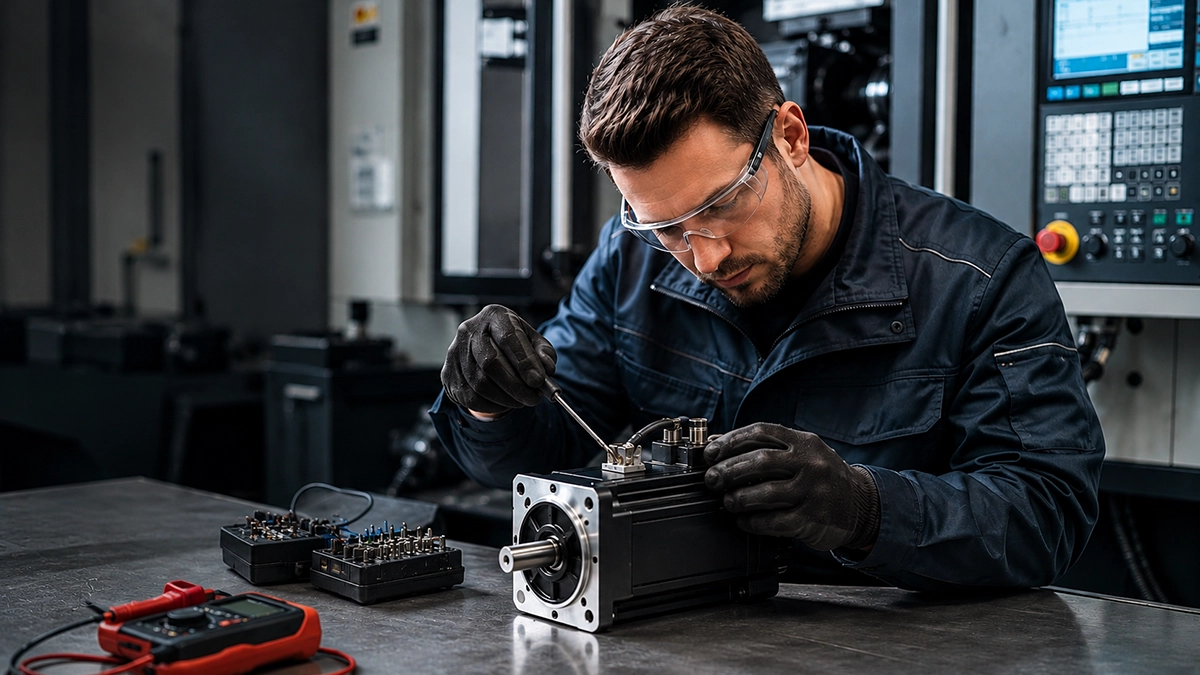
What Is Servo Maintenance?
Servo maintenance is the scheduled inspection, cleaning, calibration, and testing of servo motors, drives, and feedback devices to catch early signs of wear before they cause positioning errors or unplanned downtime.
It is distinct from servo motor repair, which addresses a servo system after a fault or failure has already occurred. Maintenance is preventive; repair is corrective. Most facilities need both a maintenance schedule to minimize failures, and a trusted repair partner for when a fault does occur.
Why Servo Maintenance Matters
Servo systems continuously monitor position, speed, and torque through feedback devices such as encoders. When any part of the system begins to deteriorate, machine accuracy is affected. Common causes include:
- • Encoder contamination or damage
- • Bearing wear
- • Loose electrical connections
- • Overheating
- • Dust and moisture inside servo drives
- • Incorrect parameter settings
- • Aging electronic components
Routine maintenance identifies these issues before they result in costly production failures.
Benefits of Regular Servo Maintenance
Improved Positioning Accuracy
Well-maintained servo systems maintain precise positioning, ensuring products meet tight manufacturing tolerances and reducing dimensional errors.
Better Repeatability
Industrial processes require identical movements over thousands of production cycles. Preventive maintenance helps maintain consistent motion accuracy and repeatable results.
Reduced Machine Downtime
Early detection of worn components prevents unexpected servo failures that can stop entire production lines.
Longer Equipment Life
Cleaning, inspection, calibration, and timely replacement of worn parts reduce stress on motors, drives, and mechanical components, extending service life.
Lower Maintenance Costs
Preventive maintenance is significantly more economical than emergency repairs or replacing complete servo systems.
Servo Maintenance Checklist: 10 Steps
A comprehensive maintenance program generally includes the following steps, performed in sequence during a scheduled service visit:
- 1. Visual inspection of cables and connectors
- 2. Cleaning of servo drives and cooling systems
- 3. Bearing inspection
- 4. Encoder testing and verification
- 5. Feedback signal diagnostics
- 6. Parameter backup and verification
- 7. Drive fault history analysis
- 8. Electrical testing
- 9. Performance calibration
- 10. Functional load testing
These procedures help maintain optimum machine performance while preventing hidden faults from developing into major failures.
Predictive Maintenance for Servo Systems
Modern manufacturers are increasingly adopting predictive maintenance to reduce unexpected breakdowns. Using advanced diagnostic techniques such as:
- • Thermal imaging
- • Vibration analysis
- • Encoder feedback monitoring
- Fault history analysis
- • Electrical waveform testing
- Performance trending
maintenance teams can detect developing problems before they affect production. Predictive maintenance pairs well with a scheduled program see how a similar approach applies to VFD preventive maintenance for related motor-control equipment.
Industries That Benefit Most
Regular servo maintenance is essential for facilities running the following processes, where even small positioning errors can affect product quality and production efficiency:
- • CNC machining
- • Packaging machinery
- • Printing equipment
- • Plastic injection molding
- • Robotics
- • Textile manufacturing
- Food and beverage processing
- Pharmaceutical production
- Material handling systems
Warning Signs Your Servo System Needs Maintenance
Schedule an inspection if you notice any of the following:
- • Positioning inaccuracies
- • Increased vibration
- • Unusual motor noise
- Servo alarms or fault codes
- • Overheatings
- Inconsistent production quality
- Reduced machine speed
- • Frequent system resets
Ignoring these warning signs often leads to more expensive repairs and longer production downtime. If a fault has already progressed to failure, see our guide on servo motor repair and production accuracy.
Why Choose Epoch Technical?
Epoch Technical is an ISO 9001:2015-certified provider of servo drive repair and industrial automation repair services across the UAE, covering servo drives, CNC systems, PLCs, HMIs, VFDs, and other industrial electronics. Our repair process includes detailed diagnostics, component-level repairs, comprehensive testing, and preventive maintenance to restore equipment reliability while minimizing downtime.
Frequently Asked Questions
Everything you need to know about servo maintenance and repair.
Conclusion
Servo systems are essential for maintaining the precision, speed, and reliability of modern industrial automation. Without regular maintenance, machine accuracy gradually declines, leading to higher downtime, increased scrap rates, and costly repairs.
A structured preventive and predictive maintenance program helps maintain positioning accuracy, improve equipment reliability, extend service life, and reduce operating costs.
If your servo drives or motors require professional diagnostics, repair, or preventive maintenance, Epoch Technical is ready to help. Contact our engineering team or explore our full range of industrial automation repair services to keep your production running efficiently while minimizing unexpected downtime.