







A Variable Frequency Drive ( VFD ) controls motor speed to match actual process demand, cutting energy use by 20-50% ( U.S. Department of Energy, Motor Systems Market Assessment ). Neglected VFDs lose this efficiency advantage through overheating, aging capacitors, and incorrect settings. Regular maintenance restores and sustains those savings.
Electric motors account for roughly 70% of industrial electricity consumption globally (International Energy Agency, 2023). Variable Frequency Drives ( VFDs ) are one of the most effective tools available to reduce that burden. Yet in most facilities, VFDs are installed and forgotten and left to degrade quietly while energy bills creep upward.
This guide explains exactly how VFD performance deteriorates, what maintenance tasks prevent efficiency losses, and what warning signs indicate your drives need professional attention.
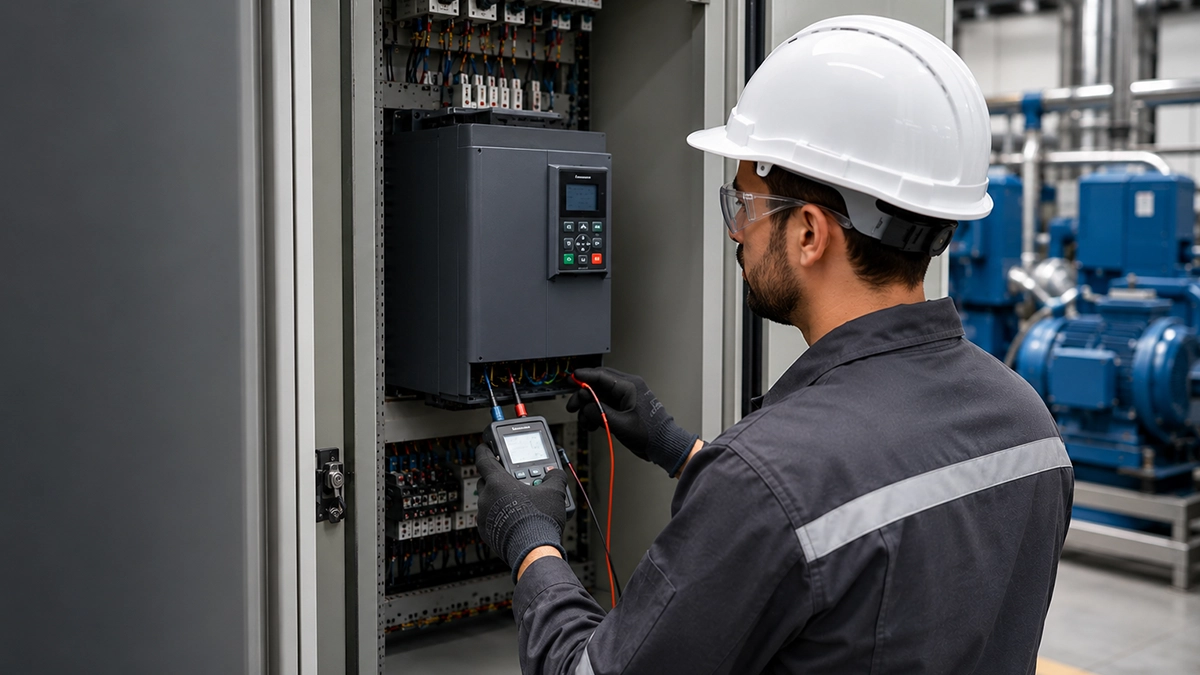
What Is a VFD and Why Does Maintenance Affect Energy Consumption?
A Variable Frequency Drive regulates AC motor speed by adjusting the frequency and voltage of its power supply. Instead of running a motor at full speed continuously, a VFD allows it to operate only as fast as the process requires.
The relationship between motor speed and power consumption follows the Affinity Laws: reducing motor speed by 20% cuts power draw by approximately 50%. This is why properly functioning VFDs deliver such dramatic energy savings in fan, pump, and compressor applications.
However, a VFD that is not maintained cannot deliver these savings reliably. Internal component degradation, cooling failures, and incorrect parameters all erode efficiency often invisibly, long before the drive trips or fails.
5 Ways Poor VFD Maintenance Increases Your Energy Bill
Clogged Cooling Systems
Industrial environments expose VFDs to dust, moisture, and airborne contaminants. When cooling fans and heat sinks become blocked, internal temperatures rise. According to Arrhenius's Rule, every 10°C increase in operating temperature roughly halves the lifespan of electronic components and measurably reduces their efficiency.
Result: Higher junction temperatures in power semiconductors increase switching losses and energy waste.
Aging DC Bus Capacitors
DC bus capacitors filter and stabilise the internal power supply. As electrolytic capacitors age, their equivalent series resistance ( ESR ) rises and capacitance falls. Industry data from ABB and Danfoss recommends capacitor inspection every 3-5 years and replacement every 7-10 years under normal operating conditions.
Result: Increased harmonic distortion, voltage ripple, and elevated risk of sudden failure.
Degraded Power Semiconductors (IGBTs)
Insulated Gate Bipolar Transistors ( IGBTs ) are the switching devices that generate the output waveform. Thermal cycling, overvoltage events, and moisture ingress degrade IGBT performance over time. Degraded IGBTs generate excess heat and electrical losses before they fail outright.
Result: Elevated energy consumption and reduced output waveform quality, which also stresses the connected motor.
Loose Electrical Connections
Vibration and thermal expansion cycles gradually loosen terminal connections inside VFD cabinets. Loose connections increase contact resistance. By Joule's Law ( P = I²R ), even small increases in resistance at high current levels generate disproportionate heat and energy waste.
Result: Energy lost as heat at terminals, plus elevated risk of arc faults and equipment damage.
Outdated or Incorrect Parameter Settings
VFD parameters set during initial installation are often never reviewed. As production processes change, motors may be operating with incorrect acceleration ramps, motor nameplate data, or control modes. A drive running in V/Hz mode where vector control would be appropriate, for example, wastes energy on magnetising current.
Result: The VFD works harder than necessary to achieve the same process output.
VFD Preventive Maintenance Checklist: 6 Steps That Protect Energy Savings
- 1. Clean cooling fans, heat sinks, and air inlet filters every 3-6 months ( more frequently in dusty environments ). Use compressed air or an industrial vacuum never solvents on electronic components.
- 2. Conduct thermal imaging inspections quarterly. Infrared cameras identify hotspots on bus bars, connections, and power components before they become failures. A temperature differential of more than 10°C above ambient at a connection point requires immediate investigation.
- 3. Test DC bus capacitors annually using a capacitance meter and ESR tester. Compare readings against manufacturer baseline values. Capacitors showing more than 20% capacitance loss or ESR above specification should be replaced.
- 4. Inspect and torque all electrical connections to manufacturer specifications at least once per year. Focus on input terminals, output terminals, bus bar bolts, and control wiring terminal strips.
- 5. Review and update drive parameters whenever process requirements change. Verify motor nameplate data matches drive settings, confirm acceleration/deceleration times are appropriate, and check that energy-saving modes ( such as automatic energy optimisation ) are enabled where applicable.
- 6. Use diagnostic tools ( oscilloscope, power analyser, or drive manufacturer software ) annually to check output voltage and current waveforms, harmonic content, and insulation resistance on motor cables.
| Maintenance Task | Frequency | Primary Benefit | Estimated Time |
|---|---|---|---|
| Clean cooling system | Every 3–6 months | Prevents thermal efficiency loss | 3060 min |
| Thermal inspection | Quarterly | Early hotspot detection | 1–2 hours |
| Capacitor testing | Annually | Prevents harmonic losses | 1–2 hours |
| Connection torque check | Annually | Reduces resistive losses | 1–2 hours |
| Parameter review | After process changes | Optimises control efficiency | 1–3 hours |
| Advanced diagnostics | Annually | Detects hidden degradation | 2–4 hours |
Warning Signs Your VFD Is Wasting Energy Right Now
Watch for these indicators each one signals efficiency loss that is already costing you money:
- Unexplained increases in electricity bills without corresponding changes in production output
- Frequent fault trips or alarm codes, particularly overvoltage, overcurrent, or overtemperature faults
- Excessive heat output from the drive enclosure or nearby switchgear
- Cooling fan running louder or faster than usual, or fan failure alarms
- Inconsistent motor speed or process output despite stable setpoints
- Drives that have not been professionally inspected in more than two years
- Visible discolouration, corrosion, or swollen capacitors on internal inspection
Any of these symptoms warrants prompt professional assessment. Continuing to run a degraded VFD does not just risk failure it guarantees unnecessary energy expenditure every hour the drive operates.
Industries That Benefit Most from VFD Maintenance Programmes
Virtually any sector operating motor-driven equipment can achieve meaningful energy savings through structured VFD maintenance. The industries with the highest return on maintenance investment include:
- Water and wastewater treatment ( pump stations running continuously 24/7 )
- HVAC and building automation systems ( large fan arrays and chiller drives )
- Manufacturing and process industries ( conveyor systems, compressors, mixers )
- Oil and gas operations ( pipeline pumps, gas compression drives )
- Ports and crane operations ( high-cycle drives under heavy load )
- Food and beverage processing ( hygienic environments with specific thermal demands )
- Mining and tunnelling ( continuous duty applications in harsh conditions )
- Metal processing ( rolling mills, presses, and induction heating drives )
In pump and fan applications which account for a large proportion of industrial motor use the Affinity Laws mean even small speed reductions produce large energy savings. Keeping drives operating at peak efficiency in these applications has an outsized financial impact.
Frequently Asked Questions
VFD Maintenance & Energy Savings
Most manufacturers recommend a basic inspection every 6–12 months, with a comprehensive service including capacitor testing and advanced diagnostics annually. Drives operating in dusty, humid, or high-cycle environments may require quarterly cleaning. Epoch Technical's engineers can recommend a maintenance schedule based on your specific installation.
Yes. Blocked cooling causes semiconductor junction temperatures to rise, increasing switching losses and reducing conversion efficiency. A VFD operating approximately 20°C above its rated temperature can consume measurably more energy while also degrading much faster than a properly cooled unit.
The most common causes include capacitor aging, cooling failure, loose electrical connections causing arc faults, overvoltage transients from the supply network, and contamination ingress. Routine preventive maintenance can detect and prevent these issues before they lead to costly downtime.
The decision depends on the drive's age, repair cost, and the availability of replacement parts. As a general guideline, if repair costs exceed 60–70% of a new equivalent drive, replacement is often the more economical option, especially since newer VFDs typically offer improved energy efficiency. Epoch Technical also provides repair-versus-replacement assessments.
Variable Frequency Drives can reduce motor energy consumption by approximately 2050% in variable torque applications such as pumps and fans. Actual savings depend on operating conditions and load profiles. Poor maintenance can reduce these savings by as much as 10–15% due to increased internal losses.
Our engineers service major VFD brands including ABB, Siemens, Danfoss, Schneider Electric, Control Techniques, Delta, and many others. We specialize in component-level repairs rather than simply replacing circuit boards, helping extend equipment life while reducing repair costs.
How Epoch Technical Supports VFD Performance
Epoch Technical provides end-to-end VFD services for industrial customers across multiple sectors: professional diagnostics, component-level repair, thermal analysis, parameter optimisation, and structured preventive maintenance programmes.
Our engineers work with all major drive brands and have extensive experience across demanding applications including process manufacturing, HVAC, water treatment, cranes, and material handling.
Whether your facility operates a single critical drive or hundreds of VFDs across multiple production lines, we help ensure your systems deliver the efficiency and reliability your operation depends on.
Conclusion
Installing a VFD is only the beginning. The 20-50% energy savings these systems promise depend entirely on keeping them in good working order. Dirty cooling, aging capacitors, loose connections, and outdated parameters all quietly erode efficiency long before they cause an outright failure.
A structured maintenance programme pays for itself. The energy savings recovered from a single well-maintained drive in a pump or fan application typically cover annual maintenance costs many times over.
Need professional VFD diagnostics, repair, or a preventive maintenance schedule? Contact Epoch Technical today to protect your energy savings and keep your drives performing at their best.