







How Voltage Fluctuations Damage Industrial Power Supplies (And How to Prevent It)
Voltage fluctuation is a variation in the electrical supply to a machine a temporary or ongoing swing above or below the equipment's rated input and it is one of the most common, most overlooked causes of industrial power supply failure. This guide focuses specifically on that one mechanism: how voltage instability, on its own, breaks down the internal components of a power supply over time. (If you're looking for the wider picture every common cause of power supply failure, not just voltage see our general guide to why industrial power supplies fail.)
Every time voltage drifts outside its designed range, the internal components of a power supply absorb extra electrical and thermal stress. Repeated enough times, that stress turns into downtime.
For maintenance engineers and plant managers, understanding why this happens and which components fail first is the difference between catching a fault during a routine inspection and losing a production line to an unplanned shutdown.
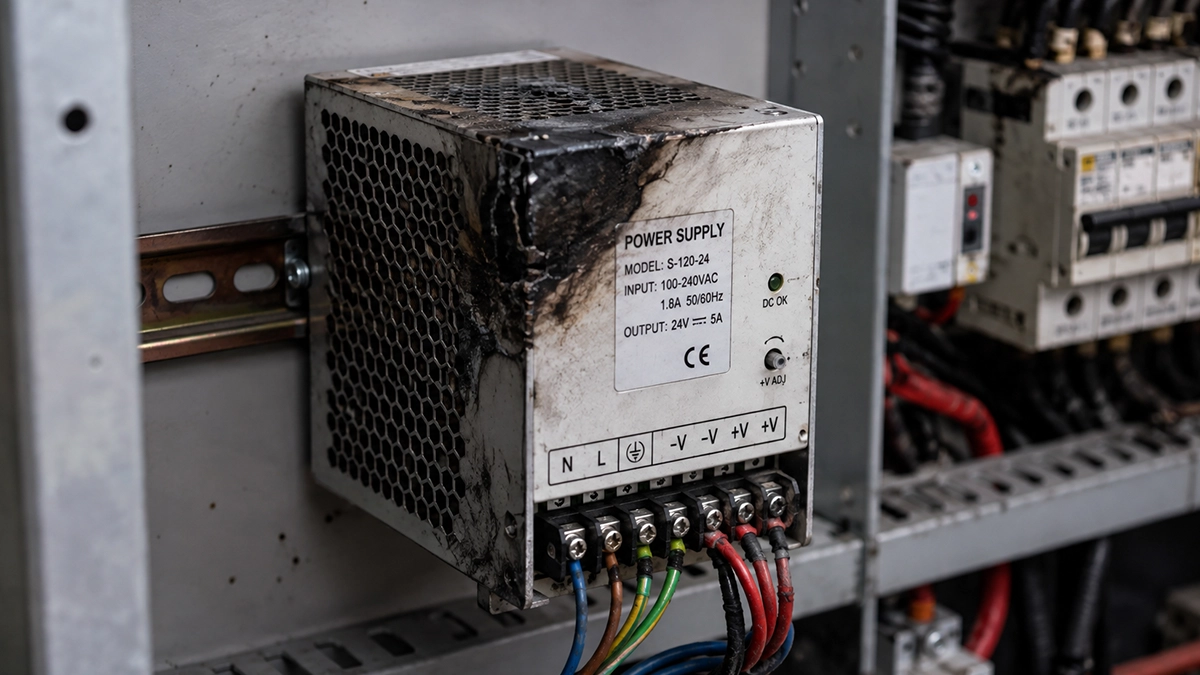
What Causes Voltage Fluctuations in Industrial Facilities?
- ● Utility grid instability - voltage sag or swell from the supplying utility
- ● Heavy machinery startup - large motors draw a current surge that briefly drops line voltage
- ● Transformer switching - tap changes or load switching create transient spikes
- ● Generator transitions - switchover between utility and backup power introduces instability
- ● Lightning strikes - induce high-energy transient spikes on distribution lines
- ● Poor electrical distribution - undersized wiring, loose connections, or unbalanced loads
Most industrial power supplies are rated for a specific input voltage window (commonly ±10% of nominal). Fluctuations that fall outside that window even briefly place cumulative stress on internal components that compounds over the life of the unit.
How Do Voltage Fluctuations Damage a Power Supply?
Industrial Switched-Mode Power Supplies (SMPS) convert incoming AC into regulated DC using a rectifier bridge, EMI filters, switching MOSFETs or IGBTs, a high-frequency transformer, a PWM controller, electrolytic capacitors, and a feedback regulation circuit. Each of these responds differently and badly to unstable input:
- ● Overvoltage stresses semiconductors and capacitors with excess heat and voltage margin loss.
- Undervoltage forces the supply to draw more current to hold its output steady, which generates additional heat and accelerates component aging.
- ● Voltage spikes deliver short, high-energy transients that can punch through insulation and junctions instantly, rather than wearing them down gradually.
The result is the same either way: heat and electrical stress compound over time, and the weakest component in the chain fails first.
Which Components Are Most Vulnerable to Voltage Fluctuations?
1. Electrolytic Capacitors
Electrolytic capacitors filter ripple voltage and stabilize DC output, and they are consistently the most common failure point in industrial SMPS units. Under continuous voltage stress, they:
- ● Heat excessively and dry out internally
- ● Develop elevated Equivalent Series Resistance (ESR)
- ● Bulge, vent, or leak electrolyte
- ● Lose filtering capability, allowing ripple to pass through to sensitive downstream electronics
Capacitor aging follows a well-established rule in electronics design: for every 10°C rise above rated operating temperature, expected capacitor life roughly halves. Since voltage fluctuations directly drive that temperature rise, even moderate, repeated instability can cut a capacitor's service life dramatically faster than steady-state operation would.
2. Rectifier Bridges
Rectifier bridges convert AC to DC, and voltage spikes are their primary threat. Diode damage from repeated transients leads to excessive heating, output instability, internal short circuits, and in the worst case complete power supply failure.
3. MOSFETs and IGBTs
These switching components handle high-frequency power conversion and are highly sensitive to voltage transients. Repeated stress causes junction overheating, gate oxide degradation, internal short circuits, and eventually catastrophic switching failure often the failure mode with the least warning.
4. PWM Controller Circuits
The PWM controller IC regulates switching frequency and output stability. Voltage surges reaching this circuit can cause startup failures, erratic regulation, or a complete shutdown of the unit frequently misdiagnosed as a "random" fault because the controller itself shows no visible damage.
What Are the Warning Signs of Voltage-Related Power Supply Damage?
Voltage-induced damage is progressive it rarely causes failure on the first exposure. Watch for:
- ● Frequent PLC or HMI resets
- ● Unstable or drifting DC output voltage
- ● Unexpected machine shutdowns
- ● Flickering operator displays
- ● Excessive heat coming off the power supply enclosure
- ● Blown fuses
- ● Swollen or leaking capacitors
- ● A burning smell near the unit
- ● Intermittent, hard-to-reproduce equipment faults
Any one of these on its own is worth investigating. Two or more together typically indicate the power supply is approaching end-of-life and should be tested before it fails during a production run.
How Does a Failed Power Supply Affect Production?
Industrial automation systems are interconnected, so a single failed power supply rarely stays contained. A failure can interrupt PLC communication, stop servo drives, disable HMIs, and halt an entire line not just the one machine it powers directly. The downstream costs typically include unplanned downtime, lost output, emergency maintenance labor, delivery delays, and a lasting drop in equipment reliability until the root cause is fixed.
The most voltage-specific defenses are:
- ● Monitor input voltage quality on a regular schedule, not just after a fault this catches drift before it becomes damage
- ● Use voltage stabilizers on circuits with known grid instability, or protect critical loads with UPS systems to isolate sensitive equipment from utility-side sags and spikes
- Replace aging electrolytic capacitors proactively, based on service hours rather than waiting for visible failure, since they're the first component voltage stress degrades
These sit alongside the broader preventive maintenance checklist cooling, grounding, load management, and inspection routines covered in our general guide to power supply failure prevention.
Routine inspection is what turns a warning sign into a scheduled repair instead of an unplanned shutdown.
Should You Repair or Replace a Power Supply Damaged by Voltage Fluctuation?
For most voltage-related faults, only a handful of components have actually failed — component-level repair targets those specific parts instead of the whole assembly. (For the cost comparison and typical savings versus full replacement, see our broader guide.)
| Component-Level Repair | Full Unit Replacement | |
|---|---|---|
| Typical cost | Lower pay only for damaged parts and labor | Higher full unit cost, even if most components are fine |
| Turnaround time | Often faster, especially for common faults like capacitor failure | Can be slower if the exact replacement model is discontinued |
| Best for obsolete/legacy units | Yes, frequently the only option once a unit is out of production | Not viable if the model is no longer manufactured |
| Environmental impact | Lower less electronic waste | Higher full unit is scrapped |
| Includes verification testing | Yes, when done by a qualified repair provider | Yes, typically covered by manufacturer warranty |
Component-level repair typically includes diagnosing the fault, replacing capacitors, MOSFETs, IGBTs, rectifier bridges, PWM controller ICs, or burned PCB components as needed, then load testing the unit before it goes back into service.
Frequently Asked Questions
At Epoch Technical, we specialize in component-level repair of industrial power supplies and inverters. Our engineers diagnose faults at the component level, replace only what's damaged, and load-test every unit before it returns to service — helping manufacturers avoid full replacement costs and keep automation systems running reliably. Get in touch with our repair team to discuss a specific unit.
Related reading: For the full picture beyond voltage-related causes, see our broader guide, Why Industrial Power Supply Failures Happen—And How to Prevent Them.