







Panel-Wide Thermal Diagnostics: Tracing Heat Failures Across PLCs, VFDs & HMIs
]Most thermal-failure content treats components in isolation: one article on power supplies, another on PCB rework, another on drives. But a control panel doesn't fail that way. Heat builds inside the enclosure as a shared resource problem — a VFD's IGBTs dump heat into the same air a nearby PLC rack has to breathe, and a blocked filter degrades every component behind it at once.
This piece looks at the panel as a single thermal system. It focuses specifically on what's different about how heat shows up in PLCs, VFDs, and HMIs/industrial PCs side by side, and gives a diagnostic sequence for tracing an intermittent fault back to its real source — rather than replacing the part that happened to fail first.
Why Component-Level Thinking Misses Panel-Level Failures
A technician who diagnoses a tripped VFD in isolation might replace a capacitor and move on. But if the real cause is a dead cooling fan three feet away, the PLC in the same enclosure will develop its own fault within weeks — and the next technician starts from zero again.
Panel-level thermal failure typically follows this chain:
- 1. A single cooling deficiency (fan, filter, spacing, or ambient load) raises the whole enclosure's baseline temperature.
- 2. The highest heat-generating component (usually a VFD or transformer) creates a local hotspot on top of that baseline.
- 3. Nearby components absorb ambient heat and radiated heat from the hotspot, pushing them past their thermal design margin.
- 4. The weakest component in that zone fails first — but it's a symptom, not the cause.
Recognizing this chain is what separates a repair that lasts from one that recurs in three months.
How the Same Heat Load Shows Up Differently by Component
This is the part that's easy to miss when each device is treated as its own topic. The same rise in enclosure temperature produces a different fault signature depending on what's sitting in that hot zone.
PLCs: Logic and Communication Faults, Not Power Faults
PLCs rarely show classic "overheating" symptoms like burning smells or visible damage. Instead, heat stresses the processor, memory, and I/O interface circuits in ways that look like software bugs:
- ● CPU faults that clear on their own after the panel cools
- ● Unexpected resets with no logged cause
- ● I/O modules dropping communication intermittently
- ● Machines stopping mid-cycle with no fault code, only to run fine the next morning
This is the hardest thermal fault to diagnose precisely because it's intermittent by nature — the PLC often tests fine on the bench, cold, and only fails after several hours running warm inside the enclosure. Faults like these are a common trigger for PLC repair requests where the customer assumes a logic or wiring fault, when the underlying cause is thermal.
VFDs: Power-Stage Faults That Look Electrical, Not Thermal
VFDs generate more internal heat than almost anything else in the panel, so their symptoms tend to look like power problems even when heat is the root trigger:
- ● Overtemperature trips that reset and re-trip under the same load
- ● Nuisance overcurrent faults that don't correlate with actual current draw
- ● Output waveform distortion as switching devices run hotter than rated
- ● Gradual increase in trip frequency over weeks as internal components degrade
Because VFD fault codes are usually electrical in name (overcurrent, overvoltage, ground fault), it's common to chase the electrical symptom for weeks before anyone checks whether the drive's heatsink or cooling fan is doing its job. This is one of the most frequent root causes we see in VFD repair cases where a drive has already been swapped once without resolving the fault.
HMIs and Industrial PCs: Display and Boot Faults
HMIs and IPCs sit in the same cabinets but fail in a visibly different way — through their display and storage subsystems rather than their logic:
- ● Backlight dimming or flicker that worsens as the shift goes on
- ● Touchscreen response lag or dead zones that appear only after hours of runtime
- ● Random reboots or failure to boot at all on hot mornings after a warm night
- ● Storage-related errors (corrupted config, slow load times) from heat-stressed drives or memory
Because these look like "IT problems," they often get routed to the wrong team — delaying the actual fix, which is usually airflow or fan-related. We regularly see units arrive for HMI repair with no fault found once the unit cools — a strong indicator the panel, not the HMI, is the real problem.
A Panel-Wide Diagnostic Sequence
Rather than diagnosing the failed device alone, trace the fault through the whole enclosure:
- 1. Log the ambient and internal panel temperature over a full shift, not a single spot check — intermittent thermal faults only show up once the enclosure reaches its worst-case temperature, usually mid-to-late shift.
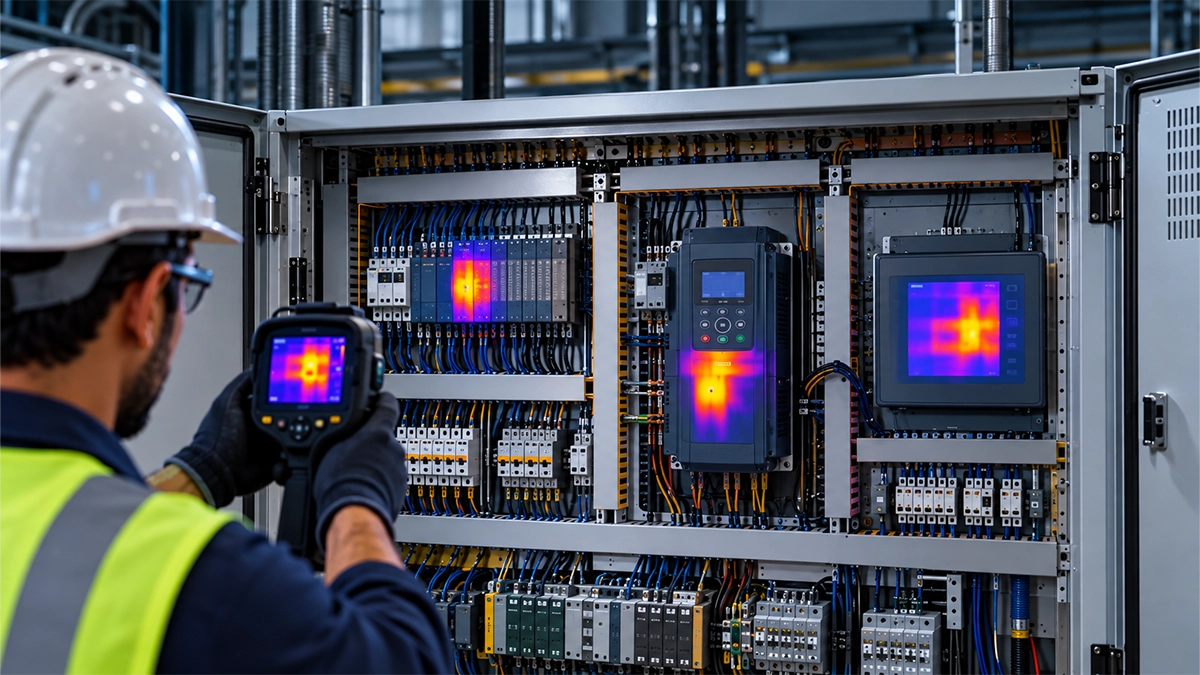
- 2. Map hotspots relative to component layout. A thermal scan showing a large temperature gap between the top and bottom of an enclosure — often more than 10°C — points to an airflow problem, not a single failing part.
- 3. Check every device in the hot zone, not just the one that faulted. If a VFD trips, check the PLC and HMI sharing that airspace for early-stage symptoms before they fail too.
- 4. Correlate fault timestamps with temperature logs. If PLC resets cluster in the same hour each day, that's a strong signal it's thermal rather than a code or wiring issue.
- 5. Verify airflow physically — fans actually spinning at rated speed, filters clear, intake and exhaust unobstructed, and correct spacing between heat-generating and heat-sensitive devices.
- 6. Reproduce under load where possible. A component that tests fine cold and fails warm needs to be tested warm; bench testing alone will miss the fault.
Real-World Scenario: Three Faults, One Root Cause
A production line was logging three separate issues over the same month: a VFD tripping on nuisance overcurrent faults, a PLC resetting once or twice per shift with no logged cause, and an HMI that occasionally failed to boot on startup. Each was initially treated as an unrelated fault and assigned to a different team.
A panel-wide thermal check found the actual cause: a cooling fan at the top of the enclosure had failed weeks earlier, going unnoticed because the panel still ran — just hotter than it should have. All three faults cleared once the fan was replaced and airflow was restored. No board-level repair was needed for any of the three devices.
Why This Matters for Repair Decisions
Once the failure is traced to a shared thermal cause, the repair decision changes. Fixing the fan or filter and reinstalling the same PLC or VFD board — rather than replacing it — is often the correct call, since the component itself may not be damaged, just stressed beyond its operating window. That's a very different outcome than assuming the first failed part was defective and swapping it out, only to see a different component in the same zone fail next.
Epoch Technical diagnoses PLC, VFD, HMI, and industrial PC faults with this panel-wide approach — tracing intermittent faults back to shared thermal causes rather than treating each device as an isolated failure. For the component-level mechanics of capacitor aging and power supply degradation, see our post on industrial power supply failures; for board-level rework and diagnostic techniques, see our industrial PCB repair guide.
Conclusion
Thermal failures rarely respect equipment boundaries — a single cooling problem can manifest as a PLC logic fault, a VFD trip, and an HMI reboot, all from the same root cause. Diagnosing them one device at a time treats the symptom, not the system. Tracing the fault across the whole panel — temperature logs, hotspot mapping, and cross-checking every device sharing that airspace — is what actually stops the failure from coming back.
Need Expert Help?
If your panel is showing intermittent faults across more than one device — PLC resets, VFD trips, or HMI issues that come and go with the shift — the cause is often shared, not separate. Contact Epoch Technical for panel-wide diagnostics and component-level repair.