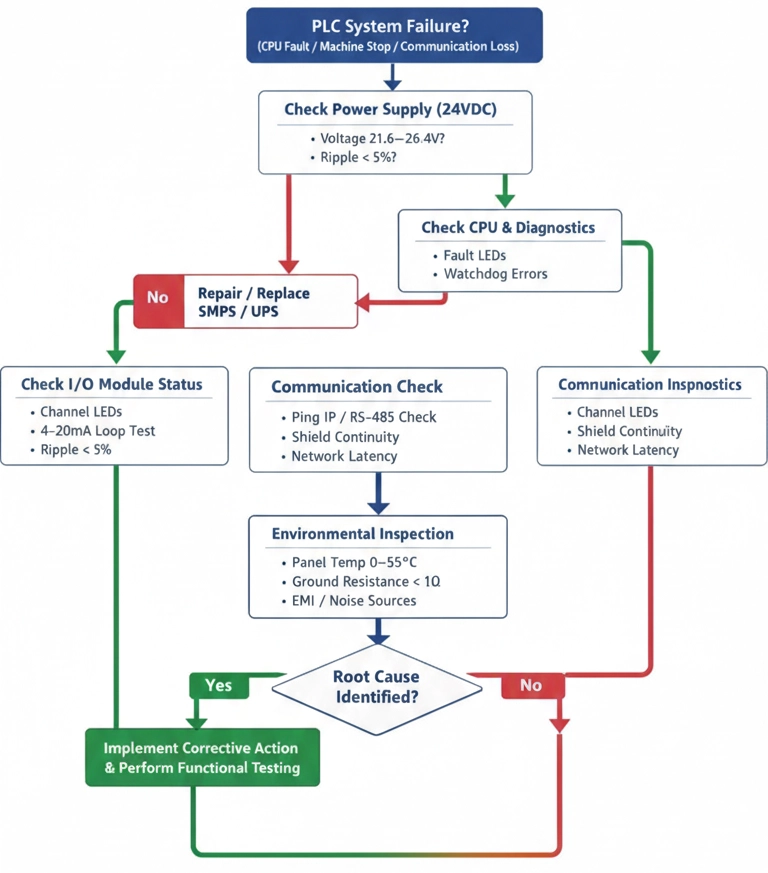







In modern industrial automation environments, a Programmable Logic Controller (PLC) acts as the deterministic core of the control architecture. From high-speed manufacturing lines to water treatment facilities and continuous process industries, PLC reliability directly impacts uptime, OEE (Overall Equipment Effectiveness), and operational safety.
At Epoch Technical, our engineering team regularly handles complex PLC repair services across multiple industrial sectors. Based on field diagnostics, PCB-level repairs, and industrial troubleshooting experience, the following are the most common PLC failure modes and structured engineering approaches to diagnose them.

Power Supply Instability and SMPS Failure
Most PLCs operate at 24V DC ±10%. Voltage dips below 21.6V or ripple above 5% can cause CPU resets and watchdog faults.
Diagnosis:
- - Measure DC ripple using an oscilloscope
- - Check AC input THD using a power quality analyzer
- - Inspect electrolytic capacitors for bulging
- - Review undervoltage diagnostic logs
Recurring instability often requires professional industrial power supply repair and detailed power quality assessment.
Solution: Install industrial UPS systems, surge protection devices, and maintain ground- ing below 1Ω.
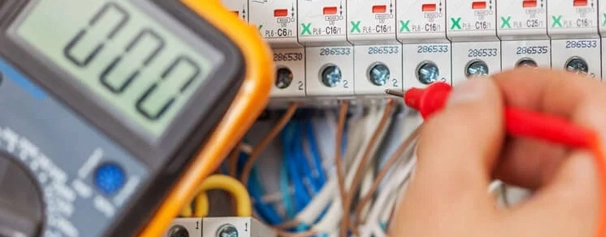
Loose or High-Resistance Wiring Connections
High resistance connections increase I2R heating and cause intermittent failures.
Diagnosis:
- - Perform torque verification as per OEM specification
- - Conduct thermal scanning using IR camera
- - Measure voltage drop across terminals
Preventive inspection programs and proper termination practices are part of structured control panel maintenance services.
Solution: Use ferrules, spring-clamp terminals, and follow IEC 60204 wiring practices.
I/O Module Failure
Overcurrent, short circuits, or inductive kickback often damage digital outputs (0.5–2A/channel typical rating).
Diagnosis:
- - Check channel LED indicators
- - Test analog loops using 420mA calibrator
- - Swap with known-good spare module
When channel-level damage occurs, expert PLC I/O module repair helps restore functionality without replacing the entire rack.
Solution: Replace faulty modules and verify field wiring isolation.
Industrial Communication Failures
Protocols such as Modbus TCP, PROFINET, EtherNet/IP, and PROFIBUS are sensitive to EMI and improper termination.
Diagnosis:
- - Ping PLC IP and monitor latency
- - Inspect shielding continuity
- - Verify RS-485 termination (120Ω)
- - Analyze packets using protocol analyzer
Complex communication errors often require advanced industrial communication troubleshooting and network diagnostics.
Solution: Use shielded industrial Ethernet cables and maintain proper network segmentation.
Programming or Scan Cycle Overload
Typical scan time ranges :
- - Small PLC: 1–10 ms
- - Large PLC system: 10–50 ms
Excessive nested loops, inefficient data blocks, and redundant instructions can increase scan time beyond deterministic limits.
Diagnosis:
- - Monitor CPU utilization percentage
- - Check watchdog timeout logs
- - Analyze scan time variability
System optimization may require professional PLC programming services to restructure ladder logic and modularize architecture
Solution: Optimize ladder logic and modularize program architecture.
Overheating and Thermal Stress
Most PLCs operate between 0°C to 5560C. Exceeding temperature limits reduces component lifespan and accelerates capacitor degradation.
Diagnosis:
- - Measure internal panel temperature
- - Inspect cooling fans and airflow
- - Conduct thermal imaging inspection
Periodic electrical panel thermal inspection helps prevent temperature-related breakdowns.
Solution: Improve ventilation, spacing, and install panel air conditioning if required.
Battery Failure
Lithium backup batteries typically last 2 - 3 years. Failure can result in program loss and memory errors.
Diagnosis:
- - Measure battery voltage (critical below 2.8V)
- - Monitor CPU battery warning indicators
Routine checks during PLC preventive maintenance reduce unexpected shutdown risks.
Solution: Replace batteries during scheduled preventive maintenance.
Memory Corruption and EMI Exposure
High-frequency noise above 30 MHz and improper grounding can cause erratic PLC behavior and firmware corruption.
Diagnosis:
- - Reload firmware and compare checksums
- - Inspect ground loops
- - Measure earth resistance (recommended ¡1Ω)
In severe cases, structured PCB-level PLC repair may be required to restore corrupted control boards.
Solution: Implement single-point grounding and segregate signal and power cables.
Grounding and Electrical Noise Problems
Ground loops often cause analog drift (±0.5mA in 420mA loops), leading to inaccurate readings and unstable control.
Diagnosis:
- - Measure ground potential differences
- - Verify shield termination practices
- - Maintain minimum 300mm separation from power cables
Comprehensive power quality assessment services help identify systemic grounding issues.
Solution: Use dedicated grounding busbars and proper bonding methods.
Faulty Sensors and Field Devices
In many situations, PLC hardware is healthy while field devices are malfunctioning.
Diagnosis:
- - Simulate loop signals
- - Compare raw vs scaled PLC input values
- - Bypass sensor safely for controlled testing
Professional industrial sensor calibration services ensure measurement accuracy.
Solution: Recalibrate or replace defective sensors.
Structured PLC Fault Diagnostic Methodology
Field experience shows that over 70% of PLC failures originate from:
- - Power instability
- - Wiring defects
- - Bypass sensor safely for controlled testing
- - Grounding errors
- - Environmental stress
-not CPU hardware failure.
At Epoch Technical, we follow a structured diagnostic framework including:
- - Root Cause Analysis (RCA)
- - PCB-level industrial electronics repair
- - Power quality measurement
- - Component-level troubleshooting
- - Preventive reliability planning
Organizations facing recurring PLC breakdowns should prioritize structured diagnostics rather than reactive replacement.
If your automation system is experiencing intermittent faults, communication errors, or unexplained shutdowns, consider professional industrial automation repair services to restore operational reliability and extend equipment lifespan.