







Common Industrial PC (IPC) Motherboard Failures in UAE and Gulf Manufacturing Plants
An Industrial PC (IPC) is a ruggedized computer built to control CNC machines, PLCs, HMIs, robotics, and other automation systems on the plant floor — as opposed to a standard office PC, which isn't built to survive a factory environment. At the core of every IPC is the motherboard, which connects and manages the components that keep automated operations running.
Across Dubai, Sharjah, Abu Dhabi, Ajman, Al Ain, Fujairah, and Ras Al Khaimah, IPCs face an especially harsh combination of stressors: sustained high ambient heat, fine airborne dust and sand, humidity near coastal sites, and the electrical noise generated by heavy machinery. These conditions accelerate motherboard wear well beyond what the same hardware would experience in a temperate climate.
Understanding the most common motherboard failure modes — and which ones can be fixed through component-level repair rather than full replacement — helps manufacturers across the Emirates catch problems early, cut unplanned downtime, and get more useful life out of hardware that's often difficult or slow to source new.
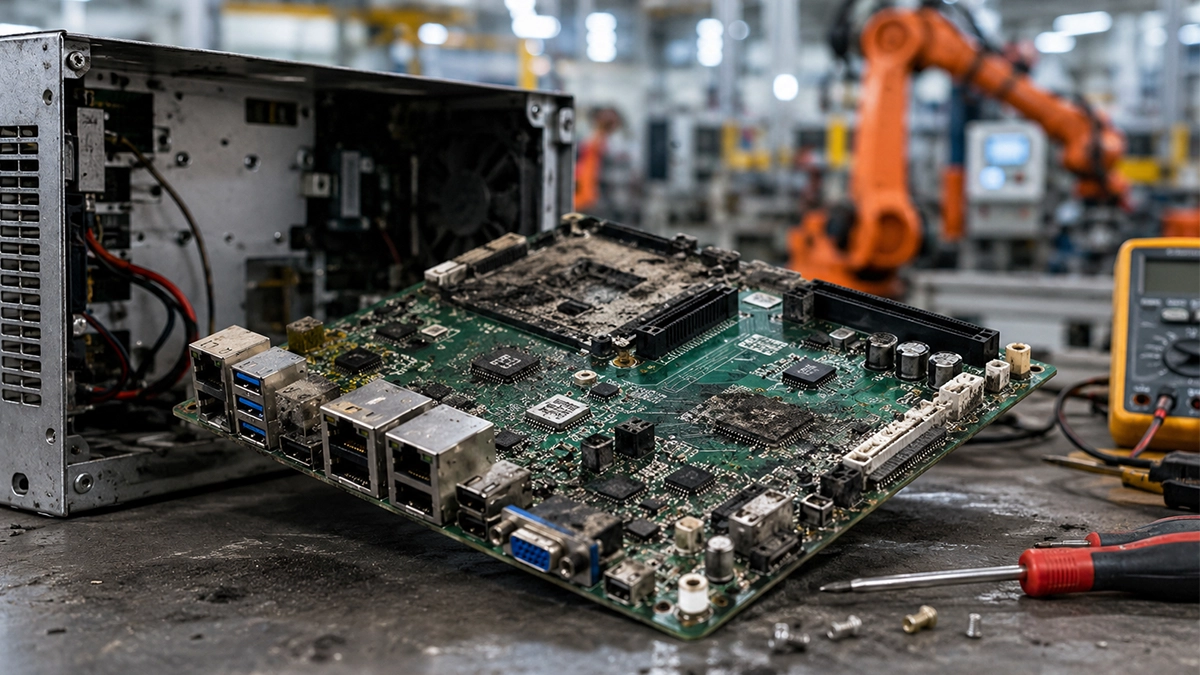
Why Industrial PC Motherboards Matter
The motherboard coordinates the CPU, memory, storage, communication ports, expansion cards, and power circuits that let an IPC talk to plant equipment in real time. It's commonly found inside CNC machines, PLC-based automation cabinets, SCADA systems, HMI operator panels, robotics controllers, and machine vision systems. Because it sits at the center of so many critical operations, even a single failed component on the board can halt a production line — which is why most of the failures below are worth diagnosing at the component level before assuming the whole unit needs replacing. This is true whether your facility runs out of Jebel Ali, Dubai Industrial City, the Sharjah industrial zones, Musaffah in Abu Dhabi, or one of the free zones in Al Ain, Fujairah, or Ras Al Khaimah.s
1. Power Supply Circuit Failure
Power-related faults are the most common motherboard problem seen in UAE manufacturing environments, largely because grid voltage fluctuations and heavy-machinery electrical noise are more common here than in more stable power environments.
The motherboard's voltage regulation circuits distribute stable power to the CPU, memory, and peripheral chips. Electrical disturbances gradually degrade these circuits until they fail outright.
Common causes: voltage fluctuations, power surges, short circuits, aging MOSFETs, failed voltage regulators, poor-quality power supplies.
Typical symptoms: IPC won't power on, random shutdowns, frequent rebooting, no display output, freezing during startup.
In most cases, replacing the damaged power components restores the motherboard without replacing the entire unit — see our Power Supply and Inverter Repair service.
2. Damaged Capacitors
Capacitor failure shows up as swollen or leaking capacitor tops and increasingly unstable boot behavior, and it's one of the most common issues we see on IPCs that run 24/7 inside enclosed cabinets in the UAE's ambient heat.
Capacitors filter and stabilize voltage across the board. Continuous high temperatures worsened by poor cabinet ventilation — cause them to deteriorate faster than their rated lifespan.
Signs of failure: swollen capacitor tops, electrolyte leakage, random restarts, boot instability, unexpected shutdowns, reduced reliability over time.
Replacing damaged capacitors is one of the simplest, most cost-effective motherboard repairs available, and often resolves intermittent instability entirely.
3. CPU Voltage Regulation Module (VRM) Failure
A failing VRM feeds the processor unstable voltage, which typically shows up as reboot loops or repeated crashes rather than a single, obvious failure event.
The VRM is responsible for delivering clean, regulated power to the CPU. When its MOSFETs, inductors, or regulator ICs degrade, the processor receives inconsistent voltage and behaves unpredictably.
IPCs running around the clock in Gulf facilities experience more thermal stress than intermittently-used units, which is why VRM failures tend to appear earlier here than the manufacturer's typical failure curve would suggest. Component-level repair can often restore these circuits by replacing the specific failed MOSFETs, inductors, or regulator ICs.
4. Corrupted BIOS or Firmware
Symptoms: boot loop, blank display, failure to complete POST, BIOS not loading, continuous restart cycles.
In many cases the BIOS chip can be reprogrammed without replacing the motherboard, which is often the fastest path back to production when a plant can't afford extended downtime.
5. Memory Slot Problems
Memory-related failures on an IPC are often intermittent and hard to pin down, which is itself a diagnostic clue constant vibration from nearby conveyors, presses, and motors gradually loosens solder joints around RAM sockets rather than causing a clean, one-time failure.
Common symptoms: random blue screen errors, memory detection failures, intermittent boot problems, unexpected application crashes, system freezes.
Repair specialists typically resolve these through solder joint repair, socket replacement, or targeted component-level rework — usually without needing to reseat or replace the entire board.
6. Communication Port Failures
If an IPC starts dropping communication with a PLC, HMI, or CNC controller intermittently, the underlying cause is more often a degraded onboard communication IC or connector than a network or software issue.
IPC motherboards typically include Ethernet ports, USB interfaces, RS-232 and RS-485 serial ports, CAN Bus interfaces, and fieldbus communication ports — all of which sit close to the machinery generating electrical noise on the plant floor.
Common symptoms: PLC communication failure, HMI connection loss, CNC controller communication errors, Ethernet port malfunction, USB devices not detected, intermittent communication drops.
Component-level repair can restore damaged communication circuits and connectors, which is usually far faster than waiting on a replacement board through UAE or international distribution channels.
7. Overheating and Thermal Stress
Overheating is arguably the single biggest driver of IPC motherboard failure across the UAE, given how many facilities in Dubai, Sharjah, Abu Dhabi, and the other Emirates run these units inside enclosed electrical cabinets in ambient temperatures that regularly exceed 45°C in summer.
Sustained heat weakens solder joints and stresses components well before their rated end-of-life.
Effects of thermal stress: cracked solder joints, processor overheating, chipset failure, PCB warping, unexpected thermal shutdowns.
Routine cabinet cleaning, proper ventilation, and active cooling maintenance meaningfully reduce overheating-related failures — and are worth prioritizing above almost any other preventive step in this climate.
8. Corrosion and Moisture Damage
Facilities near the UAE coastline, or those in food processing and chemical environments, expose IPCs to airborne moisture and contaminants that gradually corrode PCB traces, connectors, and components — often before any visible performance issue appears.
Common symptoms: oxidized connectors, rust on metal components, intermittent electrical faults, short circuits, communication instability.
Early cleaning and component-level repair can often prevent corrosion damage from becoming permanent, which is far less costly than replacing a corroded board outright. For boards already showing corrosion damage, see our PCB Repair service.
9. Burnt PCB Traces
Burnt traces typically result from an electrical overload or short circuit — incorrect wiring, a power surge, or a failed component drawing excess current — and they physically interrupt the pathways connecting motherboard components.
Common causes: incorrect wiring, power surges, component failure, excessive current flow, electrical overload.
Experienced repair engineers can rebuild damaged copper traces on multilayer industrial boards using specialized techniques, restoring full functionality without replacing the motherboard.
10. BGA Solder Joint Failure
Modern processors and chipsets are mounted using Ball Grid Array (BGA) packaging, and years of thermal cycling — heating during operation, cooling when idle — create microscopic cracks beneath the solder balls that cause intermittent, hard-to-reproduce faults.
Typical symptoms: random freezing, failure to boot, blank display, unexpected shutdowns, intermittent operation that seems to resolve itself and then recur.
Professional BGA rework equipment lets technicians repair or rework damaged solder joints while preserving the original board — this is specialized work that requires precision equipment most in-house maintenance teams don't have on hand.
Preventive Maintenance Tips for Gulf Manufacturing Plants
Given how much of the failure list above traces back to heat, dust, and power quality, a preventive maintenance routine tuned to conditions in Dubai, Sharjah, Abu Dhabi, Ajman, Al Ain, Fujairah, and Ras Al Khaimah pays for itself quickly:
- ● Clean dust and sand buildup from cooling fans and heat sinks on a fixed schedule, not just when problems appear.
- ● Inspect power supplies regularly for voltage stability, especially at sites with known grid fluctuations.
- ● Install surge protection devices on IPC power circuits.
- ● Replace worn cooling fans before they fail rather than after.
- ● Check communication cables and connectors periodically for corrosion, especially at coastal or food/chemical processing sites.
- ● Monitor cabinet internal temperatures and improve ventilation or active cooling where cabinets run hot.
- ● Schedule inspections ahead of summer peak-heat months rather than reactively.
- ● Address minor faults — a single random reboot, a flaky USB port — before they develop into full board failures.
Why Choose Epoch Technical
Industrial PC motherboard failures don't always require an expensive full-unit replacement — particularly when replacement units can take weeks to source into the UAE.
Epoch Technical specializes in component-level repair for industrial electronic equipment, helping manufacturers across Dubai, Sharjah, Abu Dhabi, Ajman, Al Ain, Fujairah, and Ras Al Khaimah restore existing hardware quickly and cost-effectively. Our repair capabilities include:
- ● Industrial PC motherboard repair
- ● Embedded Computer Board Repair
- ● PCB Repair
- ● PLC Repair
- ● Power Supply and Inverter Repair
- ● CNC controller board repair
- Industrial communication interface repair
- ● Multi-layer PCB repair
- ● Component-level diagnostics and troubleshooting
Using advanced diagnostic equipment, precision soldering, and full functional testing, we restore industrial electronic boards to reliable operating condition while minimizing production downtime. Component-level repair typically means lower repair costs, faster turnaround than sourcing new hardware, extended equipment life, less electronic waste, and preservation of your original machine configuration.
Frequently Asked Questions
Common questions about Industrial PC motherboard repair, diagnostics, and maintenance.
Facilities in Dubai, Sharjah, and Abu Dhabi tend to experience these issues most in enclosed cabinets, while coastal sites in Fujairah and Ras Al Khaimah often see accelerated corrosion caused by humidity.
Final Thoughts
Industrial PC motherboards sit at the center of modern manufacturing operations, and in the UAE they face a harsher combination of heat, dust, humidity, and electrical noise than in most other markets. Understanding the most common failure modes — from power circuit damage and capacitor aging to firmware corruption, communication faults, and BGA solder fatigue — helps maintenance teams catch problems before they become full equipment failures.
Instead of replacing costly Industrial PC hardware, UAE manufacturers can often restore their systems through professional component-level repair — reducing downtime, lowering costs, and extending equipment life. Get in touch with Epoch Technical for a free assessment of your Industrial PC motherboard.